
Data Entry Outsourcing: Cost, Benefits & How It Works
infixx
Author
Data Entry Outsourcing: Cost, Benefits & How It Works
Managing massive volumes of raw data in-house frequently drains valuable corporate resources, inflates operational overhead, and shifts focus away from strategic revenue generation. Selecting professional data entry outsourcing services allows expanding enterprises to convert complex, labor-intensive administrative tasks into streamlined, cost-effective digital workflows.
This complete operational guide breaks down the true financial models, strategic organizational benefits, implementation frameworks, and risk-mitigation standards governing data entry outsourcing.
What Is Data Entry Outsourcing?
Data entry outsourcing is the strategic business practice of contracting specialized third-party service providers to handle the collection, processing, digitizing, verification, and management of business information.
Rather than committing internal payroll to repetitive administrative tasks, companies leverage off-site data specialists backed by advanced automation tools, strict Quality Assurance (QA) protocols, and multi-tier security infrastructure.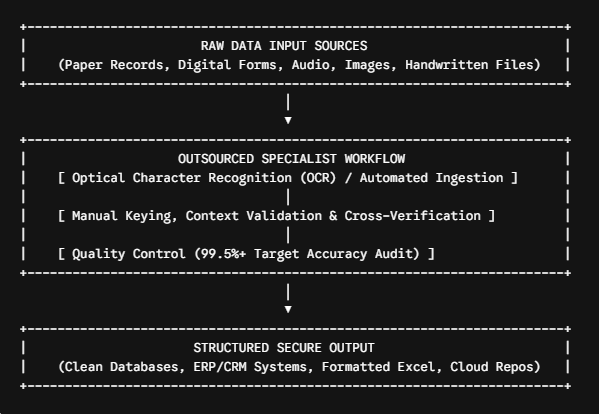
Core Categories of Data Entry Outsourcing Services
| Service Category | Primary Operational Focus | Common Deliverables / Use Cases |
|---|---|---|
| Online Data Entry | Real-time entry into web portals, cloud databases, and SaaS platforms. | Product catalog updates, CRM record hygiene, user indexing. |
| Offline Data Entry | Local processing of offline files, legacy documents, and local drives. | Offline spreadsheets, text formatting, raw file compilations. |
| Document Digitization | Converting paper records into searchable digital assets via double-keying. | Archival digitization, paper invoice conversion, PDF indexing. |
| Medical & Healthcare Data | Processing patient records while strictly adhering to privacy mandates. | EHR updates, medical billing conversion, patient chart audits. |
| E-Commerce Catalog Entry | High-volume product SKU data, imagery tags, pricing, and descriptions. | Shopify/WooCommerce catalog uploads, inventory matching. |
| Financial & Accounting Data | Precision keying of financial ledgers, bills, receipts, and audits. | Accounts payable indexing, tax document entry, bank statement reconciliation. |
Key Benefits of Outsourcing Data Entry
Outsourcing routine administrative processes yields immediate operational efficiencies and long-term financial advantages.
1. Significant Cost Reduction
Maintaining an in-house data entry team involves substantial recurring expenses beyond baseline hourly wages:
Direct Labor Overhead: Benefits, health insurance, paid time off, and payroll taxes.
Capital Infrastructure: Office square footage, workstations, hardware upgrades, and enterprise software licenses.
Recruitment & Onboarding: HR allocation for continuous hiring and continuous training cycles.
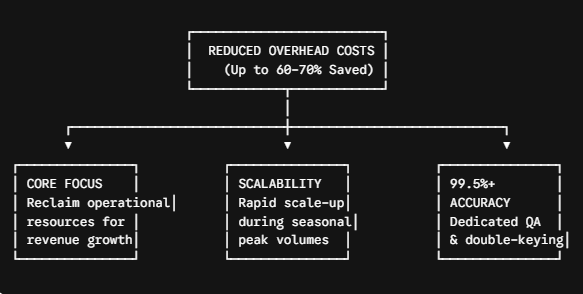
By leveraging offshore or nearshore data entry teams, businesses consistently reduce total processing overhead by 60% to 70% while shifting fixed costs into a flexible variable cost structure.
2. Sharpened Core Business Focus
When internal sales, marketing, and operations specialists spend hours formatting spreadsheets or clearing invoice backlogs, productivity drops. Delegating administrative volume to external partners allows your core employees to concentrate entirely on key revenue-generating objectives and client satisfaction.
3. Superior Accuracy and Advanced QC
Top-tier data entry agencies enforce strict service-level agreements (SLAs) guaranteeing accuracy rates between 99.5% and 99.9%. Achieving this level of precision involves multi-stage verification methods:
Double-Key Data Entry: Two independent operators key the exact same data, and software flags any discrepancies for supervisor review.
Automated Parsing & OCR Verification: Advanced optical character recognition extracts data, followed immediately by human verification to eliminate formatting errors.
Random Statistical Sampling: Quality managers routinely run audit checks across completed batches before delivery.
4. Continuous Operational Scalability
E-commerce holidays, tax deadlines, and quarterly inventory audits generate sudden volume surges. Outsourcing enables immediate team expansion without HR delays, followed by rapid scaling down once high-volume phases pass.
How Data Entry Outsourcing Works (Step-by-Step Execution)
A structured onboarding framework prevents operational friction and ensures data integrity from day one.
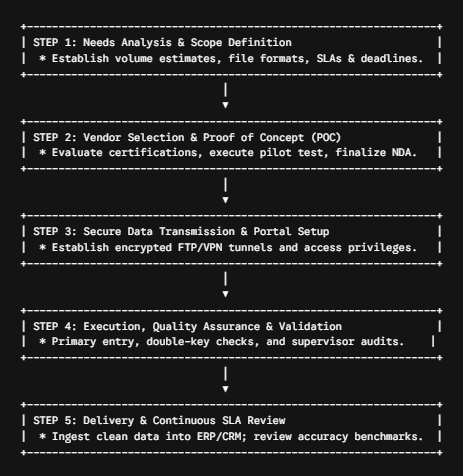
Step 1: Needs Analysis and Scope Definition
Document exact processing guidelines, expected volume runs, file formats, required turn-around times (TAT), and baseline accuracy thresholds.
Step 2: Vendor Evaluation and Pilot Run
Review potential partners against industry certifications (e.g., ISO 9001, ISO 27001). Request a small-scale Proof of Concept (POC) pilot project to test actual accuracy, communication cadence, and deadline adherence.
Step 3: Secure Protocol Configuration
Establish secure access controls. Implement encrypted transfer channels (SFTP, secure APIs, or dedicated cloud storage folders) with strict role-based access limits.
Step 4: Batch Processing and QA Auditing
Offshore specialists process incoming batches using your precise operational SOPs. Automated scripts validate formatting constraints, while internal QA leads run secondary manual checks.
Step 5: Secure Final Ingestion and Ongoing Optimization
Clean data is ingested directly into your internal systems (such as Salesforce, SAP, or custom SQL databases). Weekly reporting cycles track performance metrics against agreed-upon SLAs.
Data Entry Outsourcing Cost Models
Understanding international pricing structures helps ensure accurate budgeting and prevents unexpected service charges.
Standard Industry Pricing Structures
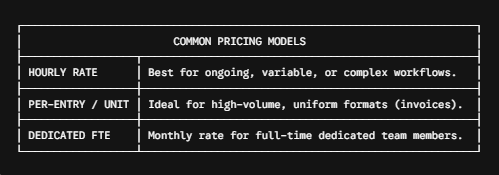
Hourly Rate Model: Pay solely for active hours logged. Ideal for projects with shifting requirements or variable task types.
Per-Unit / Per-Record Model: Pay a fixed fee per completed document, line item, or record. Best suited for high-volume invoice processing or standardized form conversions.
Dedicated Monthly FTE (Full-Time Equivalent): Secure full-time data specialists working exclusively for your company. Provides maximum operational continuity at a fixed monthly cost.
Regional Cost Comparison Breakdown
Rates vary based on regional labor economics, language fluency requirements, and technical skill levels:
| Outsourcing Region | Average Hourly Rate (USD) | Primary Operational Advantages |
|---|---|---|
| South Asia (India, Bangladesh, Pakistan) | $3.50 – $8.00 | High cost savings, deep English fluency pool, massive scalable workforce. |
| Southeast Asia (Philippines, Vietnam) | $4.50 – $10.00 | Excellent Western cultural alignment, exceptional customer support integration. |
| Eastern Europe (Poland, Romania, Ukraine) | $12.00 – $22.00 | Proximity to EU time zones, strong specialized technical and financial skills. |
| Onshore / Domestic (US, UK, Canada) | $18.00 – $35.00 | Local regulatory compliance, zero time-zone gaps, physical paper access. |
Data Security and Regulatory Compliance
Delegating data access to an external vendor requires strict adherence to international security standards.
Essential Compliance Frameworks
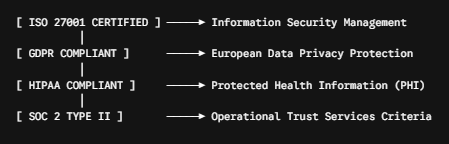
Before sharing operational access, verify that your vendor adheres to essential security standards:
ISO 27001: Demonstrates enterprise-level Information Security Management Systems (ISMS).
HIPAA Compliance: Mandatory for handling any U.S. healthcare records or Protected Health Information (PHI).
GDPR Adherence: Crucial when managing personal data belonging to European Union citizens.
SOC 2 Type II: Confirms operational security, availability, and processing integrity over extended evaluation periods.
Mandatory Physical and Digital Safeguards
Non-Disclosure Agreements (NDAs): Binding legal contracts signed at both organizational and individual employee levels.
Clean-Desk Policies: Facilities prohibiting mobile phones, physical recording devices, paper, or personal pens within data handling areas.
Network Perimeter Security: Enterprise firewalls, disabled USB ports, restricted IP access networks, and continuous data loss prevention (DLP) monitoring.
Common Pitfalls and How to Avoid Them
Even seasoned operations teams can run into hurdles during outsourcing rollouts. Use these strategies to keep your transition on track:
1. Vague Standard Operating Procedures (SOPs)
Risk: Vendor teams make assumptions when handling edge-case data errors, leading to systemic data corruption.
Mitigation: Document edge-case rules clearly using step-by-step written SOPs, annotated video walk-throughs, and specific error-handling guidelines.
2. Prioritizing the Lowest Hourly Price Over Quality
Risk: Selecting a $2/hour rate often leads to high error rates, missed deadlines, and poor security compliance.
Mitigation: Evaluate vendors based on total value—prioritizing proven accuracy, technical infrastructure, security compliance, and references over baseline rates.
3. Ignoring Time-Zone and Communication Gaps
Risk: Turnaround delays caused by mismatched communication windows.
Mitigation: Ensure your vendor provides dedicated account management overlapping with your core operating hours.
Frequently Asked Questions (FAQs)
How do I transition my in-house data entry to an outsourced provider?
Start by documenting your current data processes, error rates, and volume metrics. Request a pilot test with 2–3 vetted vendors to compare performance. Once selected, execute an NDA, establish secure access channels, and transition data in phased batches while maintaining internal backups until SLAs are consistently met.
What is the typical accuracy rate for outsourced data entry?
Professional data entry service providers maintain guaranteed accuracy rates between 99.5% and 99.9%. Top-tier vendors achieve this level of precision through automated validation checks, double-keying protocols, and dedicated internal QA managers.
Can outsourced teams enter data directly into my custom software or CRM?
Yes. Outsourced team members can work directly within your cloud-based applications (such as Salesforce, HubSpot, SAP, or custom web portals) via encrypted VPNs or restricted user accounts. Alternatively, they can deliver structured export files (CSV, XML, JSON) formatted for automated database ingestion.
Is outsourcing data entry safe for small businesses?
Outsourced data entry is completely safe for small businesses when proper security controls are enforced. Ensure your vendor signs a comprehensive Non-Disclosure Agreement (NDA), utilizes encrypted file transfers, enforces strict access permissions, and complies with standard data privacy regulations.